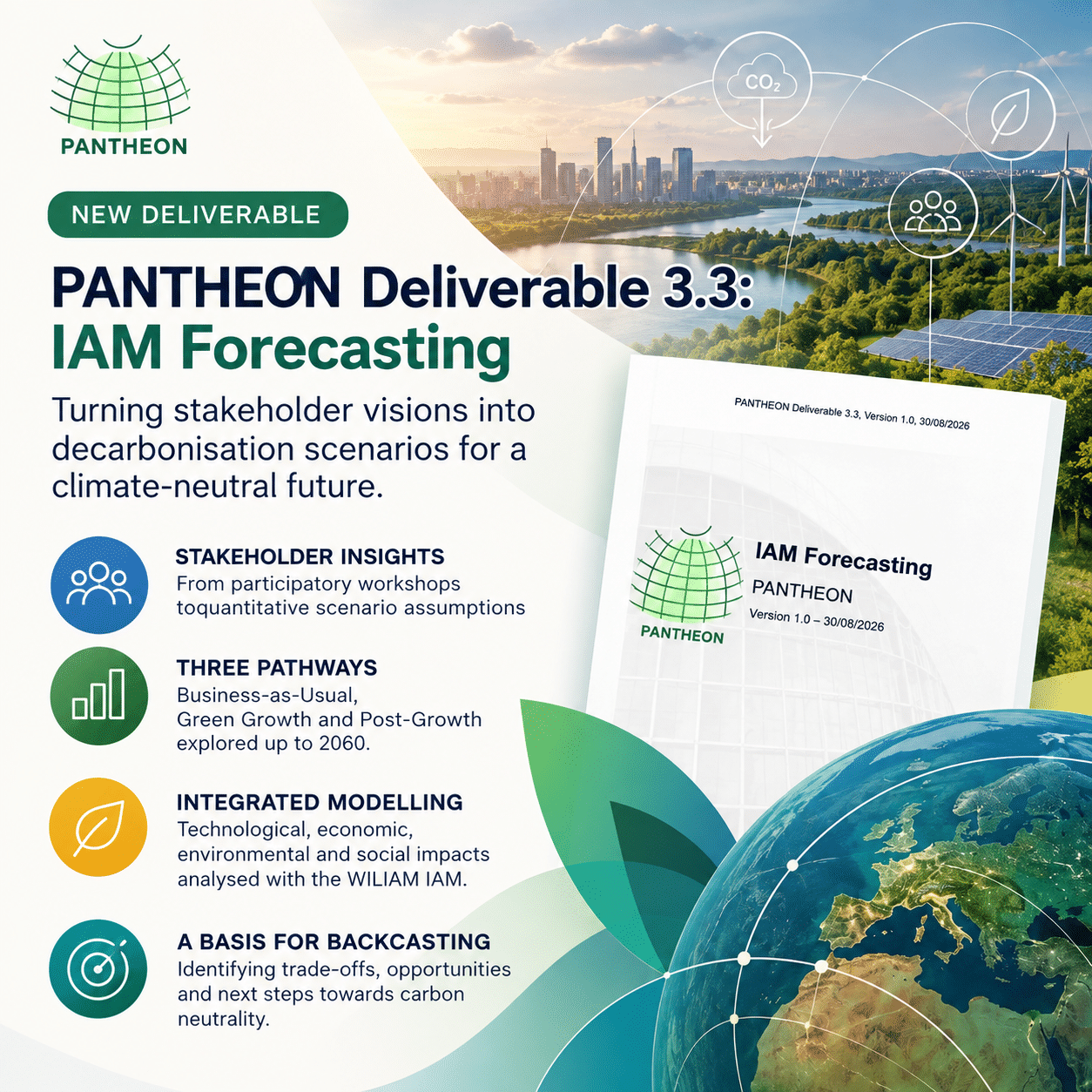
PANTHEON has reached an important milestone with the completion of Deliverable 3.3: IAM Forecasting, developed within WP3: Integrated Modelling Framework for Fore- and Backcasting Scenarios. Led by Jaime Nieto from the University of Valladolid, with contributions from colleagues across WP3 and WP5, the report brings together technological evidence, stakeholder perspectives and integrated assessment modelling to explore how different pathways towards carbon neutrality could unfold up to 2060.
The deliverable represents an important bridge between different parts of the PANTHEON project. It combines the techno-economic knowledge developed in WP2 with stakeholder insights generated through the WP5 scoping workshops and translates them into scenarios that can be simulated using the WILIAM Integrated Assessment Model. Rather than treating stakeholder engagement as something separate from modelling, PANTHEON uses an iterative process in which stakeholder priorities help shape scenario assumptions, while modelling tests the consequences, feasibility and trade-offs associated with them.
Three different futures
The analysis explores three contrasting pathways: Business-as-Usual, Green Growth and Post-Growth. Business-as-Usual continues historical trends without major additional climate interventions. Green Growth relies heavily on technological innovation, electrification, renewable energy and efficiency while maintaining economic growth. Post-Growth combines many of the same technological measures with broader changes in production and consumption, lower energy demand and greater emphasis on sufficiency, equity and well-being.
A particularly innovative element of the work is the way stakeholder perspectives are connected to modelling assumptions. During the PANTHEON scoping workshops, participants evaluated different dimensions of decarbonisation according to their direction, relevance and desired speed of change. These inputs were then used to inform the relative ambition of different scenario parameters. For example, stakeholder support for transport electrification was translated into a scenario assumption of 75% electrification of light-duty vehicles and buses by 2060. Importantly, this does not mean that stakeholders literally prescribed a 75% target. Rather, it provides a transparent and reproducible method for preserving the relative priorities expressed during the participatory process.
What do the scenarios tell us?
The results demonstrate why integrated modelling matters. Green Growth achieves a much faster expansion of renewable electricity and technological change, but continued economic expansion also drives additional demand for energy, materials and water. As a result, some of the environmental benefits of technological improvements are offset by rebound effects, with greenhouse gas emissions remaining surprisingly close to Business-as-Usual toward the end of the simulation.
The Post-Growth scenario produces a different dynamic. By combining technological transformation with lower energy and material demand, it achieves larger reductions in emissions, water use and resource pressures while also producing comparatively favourable outcomes for unemployment and regional inequality. At the same time, the report is careful not to present this as a ready-made solution: important questions concerning the socioeconomic feasibility of such pathways remain to be investigated.
Another important finding concerns uncertainty. A Monte Carlo sensitivity analysis shows that the availability of renewable resources can significantly influence the pace of transition, particularly in the Green Growth pathway. Yet the overall differences between the three scenarios remain robust. In particular, lower demand makes the Post-Growth pathway less dependent on optimistic assumptions about the maximum deployment of renewable energy. D3.3_IAM forecasting D3.3_IAM forecasting
From forecasting to backcasting
Deliverable 3.3 is therefore not the endpoint of PANTHEON’s scenario work. It provides the analytical foundation for the next stage: backcasting. The results will now be used to identify where existing pathways fall short, explore new combinations of policies and behavioural changes, and return to stakeholders with evidence about the consequences of different choices. Future scenarios will further examine issues such as the role of government, inequality, behavioural change and regional differences.
This is precisely where PANTHEON’s broader ambition becomes visible: not simply to calculate possible futures, but to create a dialogue between models, scientific knowledge and societal visions about which pathways towards carbon neutrality are desirable, feasible and sustainable.