Integrated Assessment Models are among the most influential tools used to imagine pathways toward carbon neutrality. They help policymakers explore possible futures by linking climate, environmental, economic, health, and social dynamics. But as the discussions at the 852nd WE-Heraeus-Seminar — “Future of Integrated Assessment Models: Pathways Towards Carbon Neutrality for Climate, Environment, Health and Socio-economic Co-benefits” made clear, the future of modelling is not only about better data, faster computation, or more elegant equations. It is also about asking more difficult questions.
What assumptions are hidden inside our models? Whose futures are being represented? Whose expectations become parameters — and whose remain invisible?
As Tadeusz Józef Rudek put it in his reflection on the PANTHEON project: “Decarbonisation is widely understood not as a technical fix, but as a systemic socio-technical transformation.” This may sound simple, but it changes everything. If decarbonisation is not merely a technical upgrade, then models cannot be treated as neutral machines producing objective futures. They are also spaces where values, assumptions, priorities, and political choices are organised — sometimes explicitly, often silently.
The seminar itself was designed precisely around this challenge. Its official scope emphasised the need to connect Earth system and socio-economic models, capture dynamic feedbacks, and improve how Integrated Assessment Models can inform actionable decarbonisation pathways while balancing climate goals, economic development, social equity, policy integration, and technological innovation. In other words: carbon neutrality is not just a destination. It is a contested route map.
From Technical Pathways to Socially Grounded Futures
This is where the PANTHEON project entered the conversation. Through stakeholder scoping workshops with participants from the EU and China, the project asked a deceptively simple question: what kind of post-decarbonised world do people actually want?
Rather than asking stakeholders to merely validate predefined scenarios, the workshops invited them to articulate their own visions of desirable futures: priorities, risks, trade-offs, time horizons, enabling actions, and areas of disagreement.
In the poster “Designing Stakeholder Scoping Workshops for Integrated Assessment Modelling,” Arkadiusz Szlaga presented work directly connected to PANTHEON’s efforts to bring stakeholder perspectives into IAM-related scenario development. The broader argument is clear: Integrated Assessment Models necessarily rely on socio-economic assumptions, problem framings, and normative choices that are often implicit or weakly articulated. Stakeholder engagement is therefore not a decorative participation exercise — but a methodological attempt to make these assumptions visible.
The findings are both encouraging and politically revealing. Stakeholders broadly aligned around goals such as water security, pollution reduction, biodiversity protection, food production, and CO₂ reduction. Yet they diverged on pathways: EU stakeholders tended to emphasise participatory and decentralised approaches, while Chinese stakeholders placed stronger emphasis on state-led, policy-aligned transitions.
That divergence matters. A model that treats “decarbonisation” as a single universal pathway risks mistaking consensus on goals for consensus on politics. And politics, as always, tends to return through the back door — usually without knocking.
Human in the Loop
A similar argument was developed by Aleksandra Wagner in her talk, “A Human in the Loop. Social Sciences as Catalysts for Reflexive Modeling.” Wagner argued that IAMs often generate technically feasible scenarios while leaving implicit the human, institutional, and societal factors that determine whether those futures can actually materialise. Her “human-in-the-loop” perspective positions people not only as users of model outputs, but as participants who shape, interpret, and constrain modelled futures.
This distinction is crucial. A scenario may be technically possible and still socially implausible. It may be economically optimised and politically explosive. It may be elegant on screen and not possible in lived reality. The gap between what is theoretically possible and what is socially, politically, and institutionally realisable is not a modelling inconvenience. It is the terrain of transition itself.
As Rudek noted, this forces us to ask uncomfortable but necessary questions: whose futures are being modelled, which assumptions are embedded in our tools, and whose visions remain invisible? These questions do not weaken modelling. They strengthen it. They help models become not only technically sophisticated, but also more responsible, more interpretable, and more relevant to real-world decision-making.
A Seminar Across Modelling Cultures
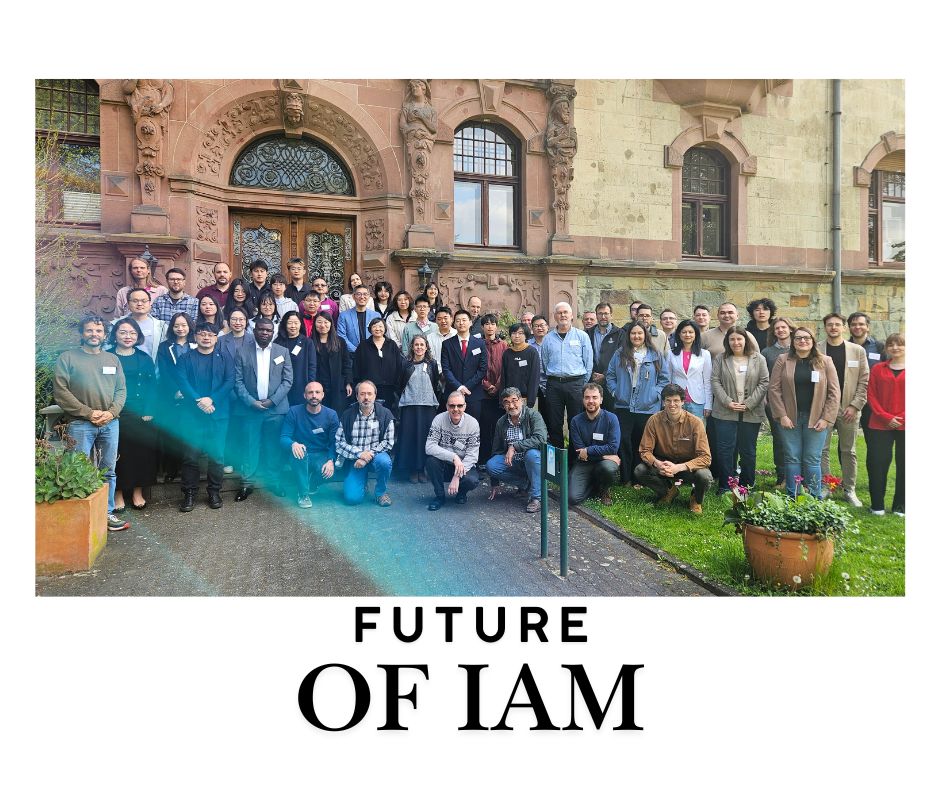
The strength of the Bad Honnef seminar was that it did not gather one modelling “team”. It brought together researchers working across climate science, energy economics, system dynamics, health, social sciences, industrial decarbonisation, circular economy, aerosols, food systems, and sustainability transitions. The official programme explicitly framed the event as an interdisciplinary exchange between leading experts, early-career researchers, and doctoral students through lectures, posters, and collaborative discussions.
Across the programme, different speakers approached IAMs from sharply different angles. Paul Brockway asked how IAMs should better include the role of energy in economic growth, warning that assumptions about energy demand reduction and energy-GDP decoupling may overestimate what efficiency alone can deliver. Chao Li pushed the discussion toward better coupling of social and natural systems, arguing that plausible climate futures require attention to feedbacks between society, climate impacts, and adaptation. Sarah Cornell, in her talk “We’re all part of the system,” raised the problem of social, ecological, and political diversities that often sit outside the formal boundaries of global models.
The social science dimension was especially visible. Konstanty Ramotowski-Kula discussed the integration of social sciences and humanities in Swiss energy modelling, focusing on research practices, epistemic hierarchies, and institutional contexts. Chris Foulds offered a critical social science provocation on how people and societies are accounted for — or excluded — in energy model outcomes and processes. His abstract warned that energy models often struggle to capture the messy, dynamic, and emergent realities of the societies they aim to serve, and that modelling assumptions are far from neutral.
Other contributions widened the field further. Matteo Pedercini discussed system dynamics modelling for integrated assessment, while Franco Ruzzenenti asked whether models can afford to neglect complexity — a question that should probably be printed on the coffee cups of every modelling workshop. Jaime Nieto focused on techno-economic and biophysical limits of the energy transition through the WILIAM model, while Wided Medjroubi addressed optimisation and techno-economic analysis of energy systems.
The China and EU dimensions were also strongly represented. Jianmin Ma examined China’s clean air action and carbon neutrality targets, while Wenjun Meng analysed how energy price volatility affects the costs and benefits of the EU energy transition. Jing Meng brought the discussion down to the plant level, showing why industrial decarbonisation requires attention to the heterogeneity of individual facilities rather than relying only on broad national targets.
From SDGs to Overshoot: Beyond Carbon Accounting
The later sessions widened the discussion beyond carbon neutrality narrowly understood. In Session C3, Prajal Pradhan presented “A threefold approach for the acceleration of Sustainable Development Goals and beyond.”This shifted attention to the broader architecture of sustainable development: social prosperity, planetary boundaries, inequalities, and the post-2030 agenda. That matters because IAMs increasingly need to speak not only to emissions trajectories, but also to the social and ecological conditions under which those trajectories become meaningful.
Friday’s Session C4 then pushed the conversation toward the newest frontier of global scenario thinking. Detlef van Vuuren discussed “Broadening Climate Mitigation Pathways in an Era of Overshoot and Global Constraints,”placing mitigation in the uncomfortable but increasingly unavoidable context of delayed action, temporary overshoot, and tightening ecological and political limits.
Paraskevi Karka followed with work on “Identifying optimal circular economy pathways: Linking prospective sustainability assessment with Integrated Assessment Model scenarios,” showing how IAM-based scenarios can support the identification of circular economy pathways. Keywan Riahi then presented “New ScenarioMIP Pathways and Insights from the Scenario Compass Initiative: What the Latest Global Emissions Scenarios Tell Us,”connecting the seminar to the latest global emissions scenario landscape and its implications for climate assessment and decision-making.
These contributions moved the discussion from the question “How do we reach carbon neutrality?” to a more demanding one: “What kinds of carbon-neutral futures are still plausible, just, liveable, and institutionally achievable?” That is a harder question — and, also the more honest one.
Why the Roundtables Mattered
Equally important were the roundtable sessions, which created space for cross-cutting questions that did not fit neatly inside any single lecture, model, or discipline. The programme included three parallel roundtable sessions on Thursday afternoon, after a day that had already connected China’s clean air action, EU energy price volatility, industrial decarbonisation, global value chains, electromobility, SDGs, air quality, health, and e-fuels.
These roundtables were crucial because they turned the seminar from a sequence of presentations into a shared intellectual workshop. They allowed participants to ask what sits between the sessions: how to connect modelling paradigms, how to make assumptions visible, how to include social and political constraints, how to deal with uncertainty, and how to prevent IAMs from becoming impressive machines that answer yesterday’s questions with tomorrow’s computational power.
In that sense, the roundtables were not an “extra” part of the seminar. They were where the seminar’s interdisciplinary promise became most concrete. They helped link the technical, social, political, and ethical dimensions of modelling — exactly the kind of dialogue the seminar’s official aims called for through lectures, poster presentations, and collaborative discussions on the future role of IAMs in decarbonisation.
The Poster Session: Futures from Many Angles
The poster session added another layer of diversity. The programme included work on energy pathway diversity, fragile cities and WASH co-benefits in Bukavu, food system transitions, methane feedbacks from wetlands, household consumption and sustainability pathways, rural–urban migration and air pollution exposure in China, sustainable aviation fuels, true cost accounting in agrifood systems, and provincial equity in China’s carbon neutrality pathway.
Among these, Arkadiusz Szlaga’s poster on stakeholder scoping workshops was particularly relevant for PANTHEON and WP5. It showed how participatory methods can be organised not as symbolic consultation, but as a structured way of feeding qualitative and semi-quantitative insights into IAM-related scenario development. Marcin Mielewczyk’s poster, “Discussing with future generations,” posed another uncomfortable question: how can we predict the behaviour of future generations, and could they bear the burden of future climate policies?
These questions matter because models do not only describe futures. They distribute responsibility across time. And future generations, annoyingly, are not available for a quick stakeholder survey.
Models Are Not Enough — But They Are Too Important to Ignore
The seminar in Bad Honnef showed that the future of IAMs will not be built by modellers alone, nor by social scientists standing outside the room and shouting “context!” through the window. It will require sustained dialogue across epistemic cultures: climate science, economics, physics, sociology, political science, engineering, public health, and stakeholder knowledge.
This does not mean that models are useless. Quite the opposite. It means they are too important to be treated as black boxes. The point is not to abandon modelling, but to make it more reflexive, transparent, and socially accountable.
As Aleksandra Wagner argued through the “human in the loop” perspective, humans are not merely external users of modelling outputs. They are part of the very conditions under which futures become possible, plausible, or blocked. As Tadeusz Józef Rudek emphasised, decarbonisation is not a technical fix, but a systemic socio-technical transformation. Together, these reflections point toward a different understanding of IAMs: not simply as machines for calculating futures, but as tools for collective learning, deliberation, and responsible simplification.
The key lesson is clear: climate futures are not simply calculated. They are co-produced in Sheila Jasanoff terms.
If IAMs are to guide societies through the next stages of decarbonisation, they must do more than project emissions curves. They must help us deliberate over futures. They must reveal trade-offs rather than hide them. They must make visible the social assumptions that silently steer technical pathways. And they must create space for the people, institutions, and communities whose lives will be shaped by the transitions those models imagine.
Acknowledgements
The seminar was made possible thanks to the dedication and hard work of the scientific and administrative organisers. We are deeply grateful to the scientific organisers: Prof. Dr. Yafang Cheng from the Aerosol Chemistry Department, Max Planck Institute for Chemistry, Germany, and Prof. Dr. Klaus Hubacek from the Energy and Sustainability Research Institute Groningen, Faculty of Science and Engineering, University of Groningen, Netherlands. We also extend our thanks to Dr. Stefan Jorda and Nadine Mock from the Wilhelm und Else Heraeus-Stiftung for the administrative organisation and support.
Special thanks are also due to the broader organising team, especially Dr. Wenjun Meng and Dr. Nuccio Ludovico, for their commitment, care, and intellectual energy in creating a seminar space that encouraged genuine interdisciplinary dialogue between modelling communities, social sciences, and climate policy research.
Their work made the seminar not only scientifically rich, but also open, welcoming, and genuinely collaborative.
In the end, the human in the loop is not a complication.
It is the point.
Because a model without humans may be clean, coherent, and computationally impressive.
But a transition without humans is not a transition.
It is just a spreadsheet with ambitions.